Effect of traditional games on learning interest among english education undergraduates: a one-group pretest– posttest study
DOI:
https://doi.org/10.67923/pest.v1i2.26Keywords:
Traditional games, Interest in learning, Students.Abstract
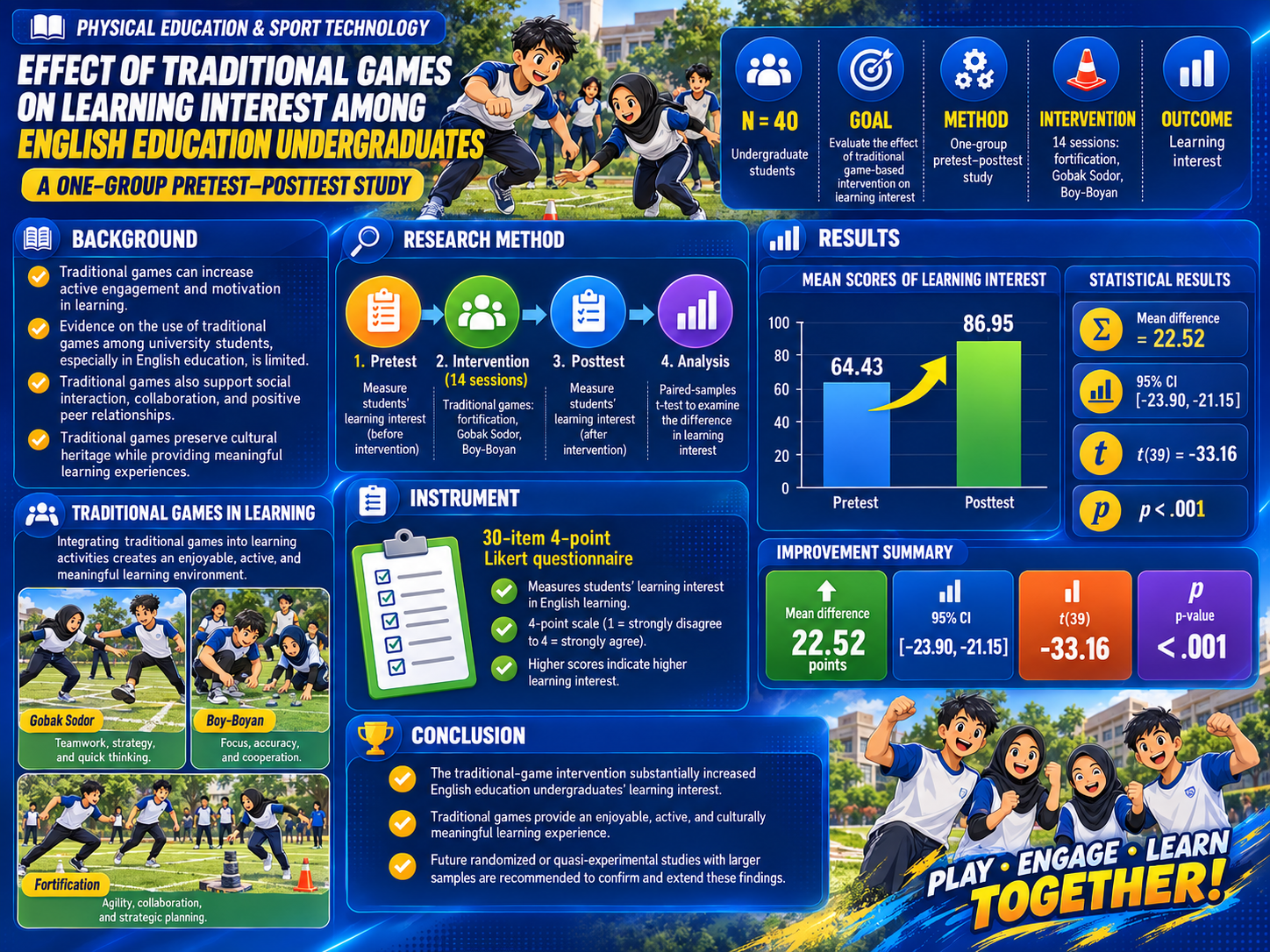
Background: Traditional games may increase students' engagement in active learning, but evidence among university students is limited. Objective: To evaluate the effect of a traditional game-based intervention on learning interest among English Education undergraduates. Methods: One-group pretest–posttest study with N = 40 undergraduate students. The intervention consisted of 14 sessions of traditional games (fortification, gobak sodor, boy-boyan). Learning interest was measured using a 4-point Likert questionnaire (30 items; source/validated instrument 0.95). Data were analyzed with paired t-test (or Wilcoxon if normality of differences violated); effect size (Cohen's d) and 95% CI were calculated. Ethics approval and informed consent were obtained. Results: Mean learning-interest score increased from 64.43 (SD = 5.18) to 86.95 (SD = 5.73). Paired t-test showed a significant increase (mean diff = 22.52, 95% CI [-23.90, -21.15], t (39) = -33.16, p < 0.001. Conclusion: The traditional-game intervention substantially increased students' learning interest. Recommended: future randomized controlled or quasi-experimental studies, with larger samples and validated instruments, to confirm causality
Downloads
Published
How to Cite
Issue
Section
License
Copyright (c) 2026 Erliz Juwita Novitasari, Adi Rahadian

This work is licensed under a Creative Commons Attribution-ShareAlike 4.0 International License.