Analysis of sports supplement knowledge and consumption behavior among members of brother fitness
DOI:
https://doi.org/10.67923/pest.v1i2.34Keywords:
sports supplement knowledge, supplement consumption behavior, fitness community, dietary supplements, health educationAbstract
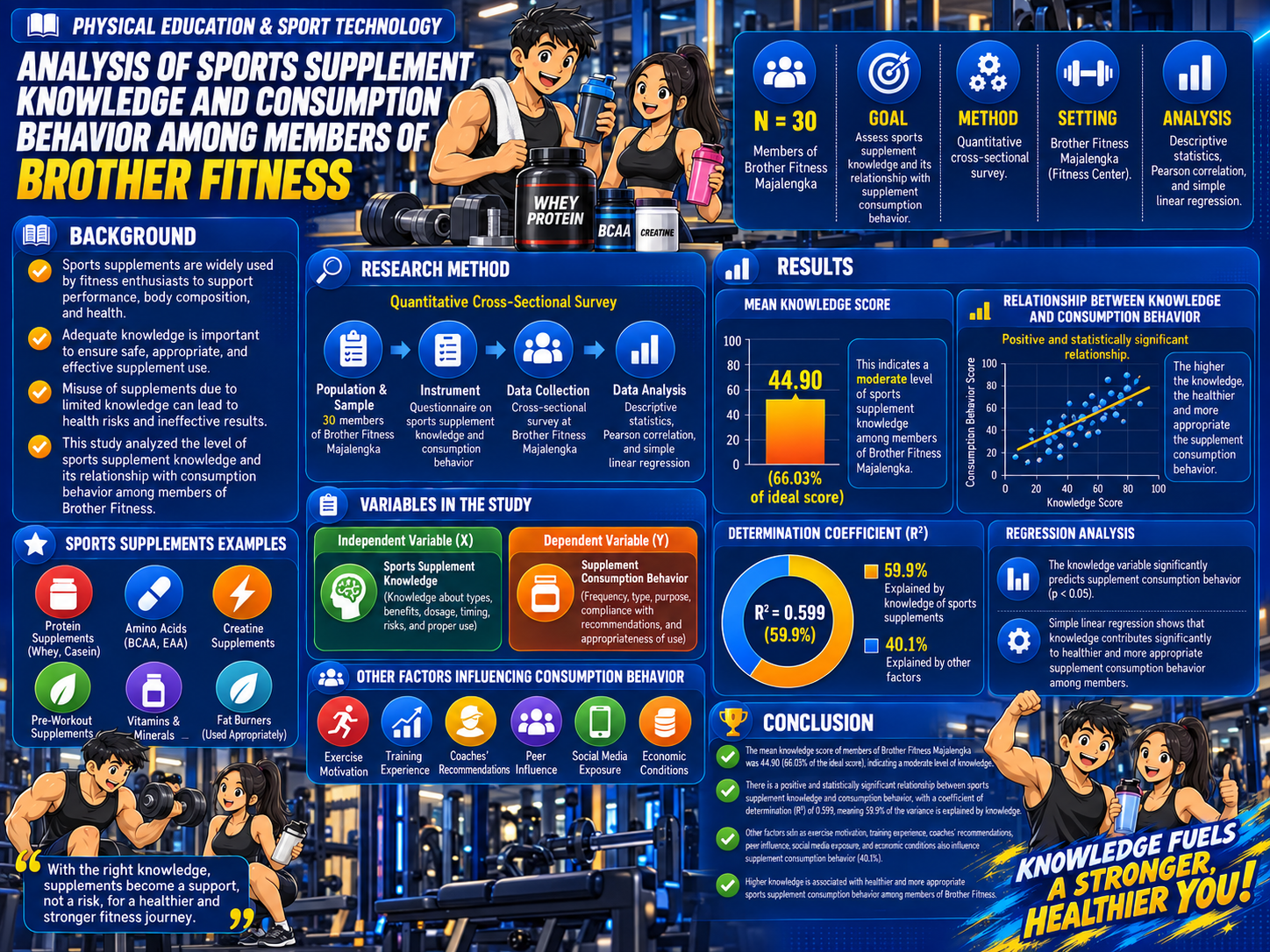
The use of sports supplements among physically active individuals has increased substantially alongside the growing popularity of healthy lifestyles and fitness activities. However, the widespread consumption of sports supplements is often not accompanied by adequate knowledge regarding their benefits, appropriate dosage, safety, and potential risks. This study aimed to assess the level of sports supplement knowledge among members of Brother Fitness Majalengka and examine the relationship between sports supplement knowledge and supplement consumption behavior. A quantitative approach with a cross-sectional survey design was employed. The study involved 30 members of Brother Fitness Majalengka selected through purposive sampling. Data were collected using a validated and reliable questionnaire. Data analysis included descriptive statistics, assumption testing, Pearson product–moment correlation, and simple linear regression using IBM SPSS Statistics version 26. The findings revealed that respondents' level of sports supplement knowledge was moderate, with a mean score of 44.90 (66.03% of the ideal score). Inferential analysis demonstrated a positive and statistically significant relationship between sports supplement knowledge and supplement consumption behavior. The coefficient of determination (R² = 0.599) indicated that sports supplement knowledge explained 59.9% of the variance in supplement consumption behavior, while the remaining 40.1% was attributable to other factors, including exercise motivation, training experience, coaches' recommendations, peer influence, social media exposure, and economic conditions. The study concludes that higher levels of sports supplement knowledge are associated with healthier and more appropriate supplement consumption behavior among fitness community members. These findings highlight the importance of evidence-based educational programs to improve sports supplement literacy and promote safe and responsible supplement use among physically active populations
Downloads
Published
How to Cite
Issue
Section
License
Copyright (c) 2026 Muhammad Ripaldo, Ali Priyono, Udi Sahudi, Indrayogi

This work is licensed under a Creative Commons Attribution-ShareAlike 4.0 International License.