Effectiveness of the culminating event stage in a Gobak Sodor-Based Sport Education model on elementary students' learning enthusiasm
DOI:
https://doi.org/10.67923/pest.v1i2.36Keywords:
learning enthusiasm, culminating event, Gobak Sodor, physical education, Sport Education Model, elementary schoolAbstract
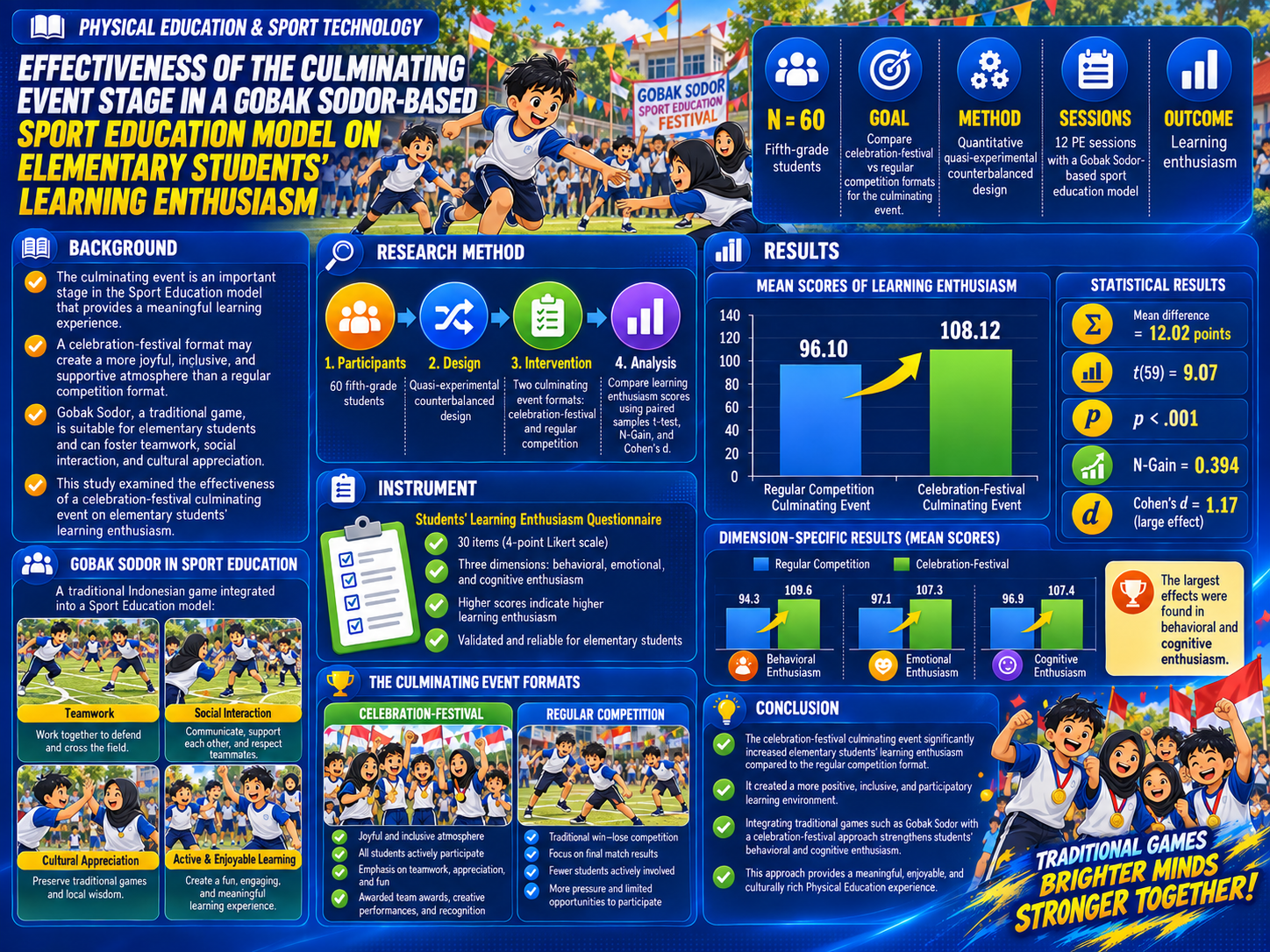
This study examined whether a celebration-festival format for the culminating event in a Gobak Sodor-based Sport Education Model produced greater learning enthusiasm than a regular competition format among elementary school students. Design: A quantitative quasi-experimental counterbalanced design was used. Methods: Sixty fifth-grade students from two intact classes at SDN Jatirahayu IV, Bekasi, Indonesia, completed 12 physical education sessions. Each class experienced six regular-competition sessions and six celebration-festival sessions in opposite sequences. Learning enthusiasm was assessed after each session using a 25-item five-point Likert questionnaire covering affective, cognitive, behavioral, and persistence dimensions. Descriptive statistics, paired-samples t-test, Wilcoxon signed-rank test, normalized gain, and Cohen’s d were used. Results: Festival scores were higher than regular-competition scores (108.12 vs. 96.10), with a mean difference of 12.02 points, t(59)=9.07, p<.001, N-Gain=0.394, and d=1.17. The largest effects occurred for behavioral and cognitive enthusiasm. Conclusion: A deliberately designed celebration-festival culminating event can strengthen students’ enthusiasm and create a more participatory and meaningful physical education experience.
Downloads
Published
How to Cite
Issue
Section
License
Copyright (c) 2026 Jajang Nurjaman, Adang Suherman, Abdul Aziz

This work is licensed under a Creative Commons Attribution-ShareAlike 4.0 International License.